


A new destination has emerged in recent years in the Peloponnese. It is the Municipality of Argos-Mycenae, which stands as a living museum of both ancient and modern history of the country.
Today Argos blends the old with the new, with large pedestrianized areas, spacious squares, restaurants, and café-bars that stand out. Less than an hour and a half from Athens, it can easily be visited as a day trip.

With Argos as a starting point, one can explore the coastal area from Nea Kios to Kiveri, with their unique fish taverns as well as hidden gastronomic spots serving delicious traditional dishes, such as the tavern Spilia.
But the wider area, beyond the unique archaeological site of Mycenae, also holds a breathtaking monument long forgotten by history that captivates visitors. This is the Pyramid of Elliniko, with its unique magnetic field which, according to the University of Edinburgh, predates the pyramids of Egypt.

Argos, the oldest continuously inhabited city in Europe and in Greece, despite the destructions it has suffered at times from raiders and conquerors, was always rebuilt in the same location. This is confirmed even today by archaeological excavations on construction sites, which continue to reveal traces of life from earlier times.
As the oldest city of Greece, it participates in the Network of the Oldest Cities of Europe and constitutes the largest open-air museum in the country, with numerous and unique finds representing every historical period of the Greeks. It offers visitors a wealth of monuments from prehistoric and historical times, museums, historic churches and rich ecclesiastical relics, the old town, distinctive architectural features, neoclassical buildings, and more.
It should be noted that the Municipality of Argos-Mycenae was established in 2010 under the “Kallikratis” Program. It was created from the merger of six pre-existing municipalities and two communities, which functioned from 01-01-1999 until 31-12-2010, having been established in 1997 under the “Kapodistrias” Plan. These were the Municipality of Argos, the Municipality of Mycenaeans, the Municipality of Koutsopodi, the Municipality of Lerna, the Municipality of Lyrkeia, the Municipality of Nea Kios, the Community of Alea, and the Community of Achladokampos, which were subsequently transformed into Municipal Units. The seat of the expanded Municipality of Argos-Mycenae was designated as Argos, with Mycenae as its historical seat. The boundaries of the Municipality essentially correspond to the boundaries of the former Province of Argos.

Visit to the Byzantine Museum of the city
The Byzantine Museum of Argolis is housed in the western and southwestern wings of the Kapodistrias Barracks, which dominate the center of Argos.
The Barracks complex, a listed historic building, is located in a central part of the city and in close proximity to the neoclassical building of the Municipal Market and the Archaeological Museum of Argos.
Tour of the Ancient Theater/Ancient Agora
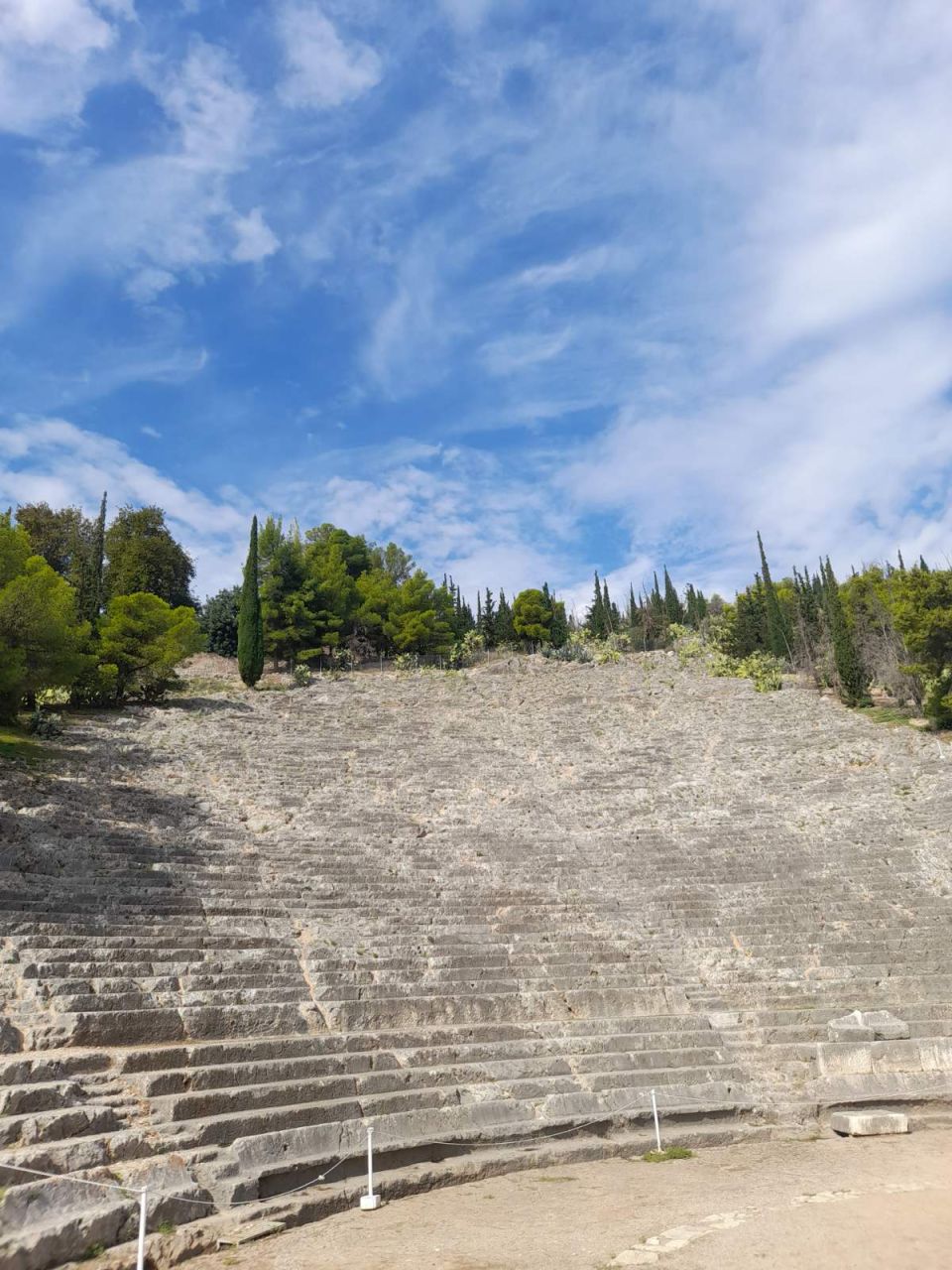
On the southeastern slopes of Larisa Hill, the Theater was founded during the Hellenistic period (300–250 BC). With a capacity of about 20,000 spectators, it is one of the largest ancient theaters in Greece. Today its capacity does not exceed 4,000 seats. Throughout its long history, it hosted the musical and dramatic contests of the Nemean Games, as well as competitions in honor of Hera. During Roman times, contests in honor of the emperor are also believed to have been established.
Larisa Castle
The history of fortifications on Larisa Hill begins in prehistoric times and extends up to the period of the Greek Revolution of 1821. Following the city of Argos through its long history, from the prehistoric era onward, it always served as a fortified observatory and the last line of defense for the city.
Kefalari
Kefalari is a beautiful village. Its houses are spread over a wide area, built among tall trees and orchards. To the west of the village rises Mount Chaon. The name is most likely derived from the verb “chaino” (to gape), because on the southern slopes of the mountain there is a cave approximately 110 meters deep. This cave was used as a refuge and dwelling by people of the prehistoric period, as shown by traces and findings uncovered by German speleologists in 1970. The cave was also used as a safe shelter during the bombings of April 1941.
Pyramid of Elliniko
The Pyramid of Elliniko (previously known as the Pyramid of Kefalari) is a rare structure which, with its imposing and dynamic form, impresses visitors. It is located on the edge of the village of Elliniko in Argolis, about two kilometers from Kefalari. According to a statement by the academic P. Theocharis, the monument was built in 2720 BC. The dating was placed in the Early Helladic III period using the scientific method of thermoluminescence.

The traveler Pausanias mentions that the monument was a polyandrium (a communal tomb of warriors) of the Kenchreans. Later scholars speculate that it was a funerary monument, or a watchtower, or even an ancient observatory, because along with another pyramid that once stood nearby, it was oriented toward the constellation Sirius. The location of the monument is of strategic importance, as it controlled the land route from Argos to ancient Hysiae and Tegea, as well as the entrance to the Argolic Gulf, and is visible to the naked eye from the ancient cities of Nafplio and Tiryns. For this reason, many believe that the Danaans used the monument as a watchtower, to observe, anticipate, and confront possible enemy attacks (fryktos = burning torch). A comparison of the monument with the ancient walls on Larisa Hill in Argos, the acropolis of Achladokampos (ancient Hysiae), or the Kritirion of ancient Argos (the oldest court in the world) reveals a close relationship among them in terms of craftsmanship and construction date.
Visit to the Archaeological Site of Mycenae
The need for a new archaeological museum to store and display the findings of over a century of excavations at Mycenae became urgent in the early 1980s, when Georgios E. Mylonas, in collaboration with the Ministry of Culture, chose the site in the northern area of the Acropolis, overcoming objections from local representatives who wished the museum to be built in the nearby settlement.

Tour of the Museum of Mycenae
The Archaeological Museum of Mycenae is located north of the Acropolis of Mycenae, within the accessible archaeological site of the same name. Its exhibits are representative samples of the life and funerary beliefs of the Mycenaeans, as well as of the achievements of Mycenaean civilization, which decisively influenced the creation of Greek civilization in historical times.
